Does Your Child Really Sleep Well? Try This 5-Second Pediatric Sleep Check
Does Your Child Really Sleep Well? Try This 5-Second Pediatric Sleep Check
Your child goes to bed at 8:30 and wakes up at 7:00. That's more than 10 hours of sleep.
But here's a question parents don't always think to ask:
Was it good sleep?
A child can spend plenty of time in bed but still struggle to get the healthy, restorative sleep their growing body and brain need if breathing is repeatedly disrupted during the night.
Snoring, mouth breathing, tossing and turning, unusual sleeping positions and even daytime behavior can provide clues that a child's sleep deserves a closer look.
At Knoxville Sleep Solutions in Knoxville, TN, Dr. Terrie Cribbs helps families understand the connection between breathing, airway development and healthy sleep.
And some of the clues are things you can begin noticing at home in just a few seconds.
What Is the 5-Second Pediatric Sleep Check?
You don't need any special equipment.
You don't need to wake your child up.
You simply need to know what to look—and listen—for.
The 5-Second Pediatric Sleep Check encourages parents to notice several simple things:
Does your child snore?
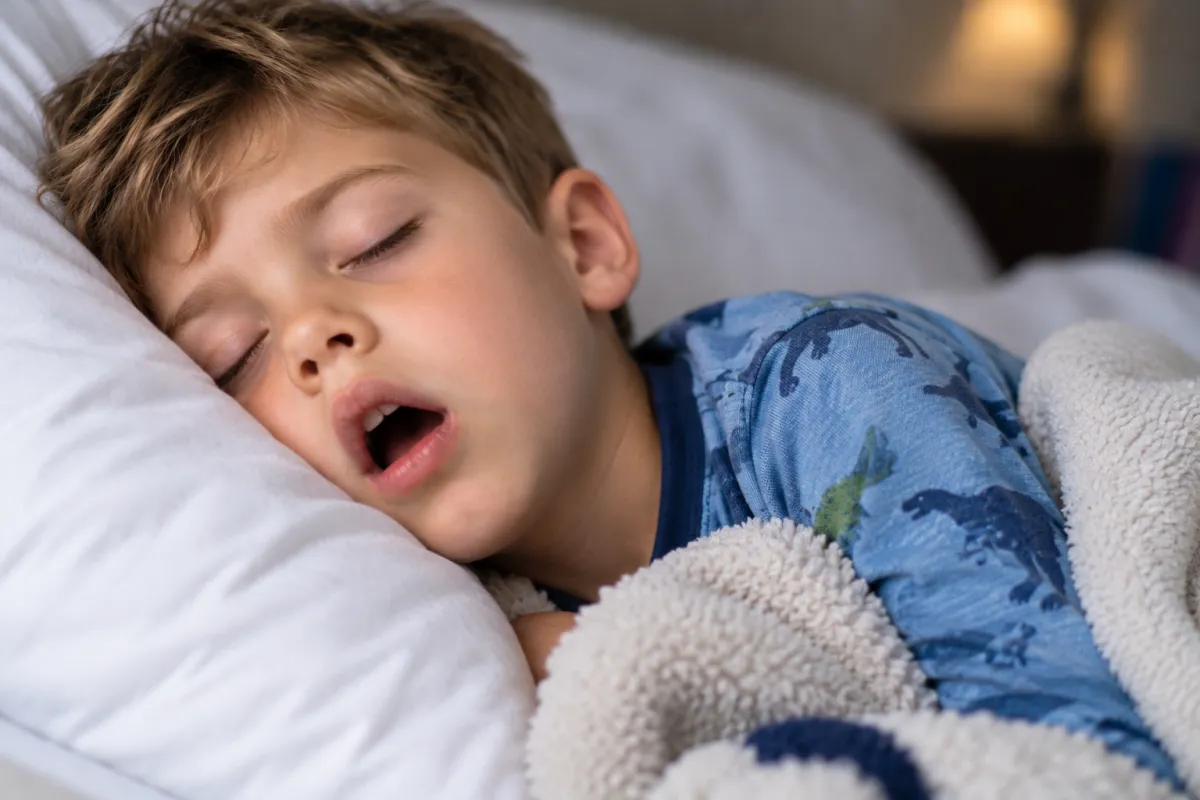
Do they sleep with their mouth open?
Do they toss, turn or sleep restlessly?
Are there attention, behavior, mood or school concerns during the day?
What does their facial profile look like?
Do their baby teeth have spaces between them, or are they tightly touching?
None of these observations alone tells you that your child has sleep apnea.
Think of them as pieces of a puzzle. One piece may mean very little. When several begin appearing together, however, it may be time to take a closer look.
1. Listen: Does Your Child Snore?
Many parents are surprised to learn that frequent snoring in children is something worth paying attention to.
An occasional snore when your child has a cold or stuffy nose is one thing.
Frequent or loud snoring is different.
Listen to your child after they've been asleep for a while.
Do they snore regularly?
Does their breathing sound labored or noisy?
Do you ever hear them gasp or choke?
Have you noticed pauses in their breathing?
Snoring is one of the common symptoms healthcare professionals consider when screening children for obstructive sleep apnea and other forms of sleep-disordered breathing.
It doesn't automatically mean your child has sleep apnea, but regular snoring shouldn't simply be dismissed because they're a child.
2. Look: Is Your Child Sleeping With Their Mouth Open?
Once your child is asleep, look at their mouth.
Are their lips comfortably together, or is their mouth hanging open?
Then start paying attention during the day.
What happens while they're watching television, doing homework or riding in the car?
Do they routinely sit with their mouth open?
Children are designed to breathe primarily through their noses. Persistent mouth breathing can have several causes, and it is one of the symptoms healthcare professionals consider when screening children for sleep-disordered breathing.
We're not talking about the occasional stuffy nose.
We're looking for a pattern of mouth breathing during the day, at night, or both.
If you regularly notice it, it's worth asking why.
3. Watch: Is Your Child a Restless Sleeper?
Some children look as though they've run a marathon by morning—and they never left the bed.
Blankets are on the floor. Pillows have migrated across the room. The child who started at the top of the bed somehow wakes up sideways at the bottom.
Kids move in their sleep, of course.
But consistently restless or unusual sleep is something parents should notice.
Watch for:
Frequent tossing and turning
Repeated waking
Unusual sleeping positions
Sleeping with the neck stretched or extended
Excessive sweating during sleep
Mouth breathing
Gasping or choking
Pauses in breathing
These can be among the signs considered when evaluating a child for a possible sleep-related breathing disorder.
A child can be in bed for 10 hours without necessarily getting 10 hours of healthy, restorative sleep.
That's why we want parents to look beyond the clock and pay attention to the quality of their child's sleep.
4. Look at the Child You See During the Day
This is where pediatric sleep problems can become especially confusing.
When adults don't sleep well, we tend to look tired.
We drag ourselves through the morning and start negotiating with the coffee pot.
Children don't always react to poor-quality sleep the same way.
In some children, inadequate or disrupted sleep may be associated with:
Difficulty concentrating
Hyperactivity
Irritability
Emotional outbursts
Behavioral concerns
Difficulty waking in the morning
Problems at school
The American Academy of Pediatric Dentistry notes that untreated pediatric obstructive sleep apnea can be associated with learning and behavioral problems and that some children may be incorrectly diagnosed with ADHD.
That doesn't mean a child who is hyperactive or struggling in school has a sleep disorder. There are many possible explanations for those behaviors.
It does mean that sleep deserves a place in the conversation.
If you're seeing daytime concerns, think about what's happening at night, too.
5. Look at Your Child's Profile
Now we're going to look somewhere parents may not expect.
Have your child stand naturally and turn sideways.
Look at the relationship between the forehead and chin.
Does the chin appear to sit noticeably behind the forehead? Does the lower jaw look as though it sits back?
The size and position of the jaws are part of a child's facial growth and development, and craniofacial characteristics are among the factors healthcare professionals may consider when evaluating children for sleep-disordered breathing.
This isn't something you should try to diagnose by looking at your child's profile.
You're simply becoming a better observer.
For Dr. Terrie Cribbs, the facial profile is another piece of information that can be considered along with a child's breathing, sleep patterns, oral development and other findings.
6. Finally, Look at Their Smile
What could baby teeth possibly have to do with sleep?
More than most parents would expect.
Take a look at your child's primary—or baby—teeth.
Do you see spaces between them?
Or are the teeth tightly touching with little or no space?
Baby teeth are smaller than the permanent teeth that will eventually replace them. As a child grows, the jaws and dental arches develop as well.
When Dr. Cribbs sees primary teeth with very little spacing, it may prompt her to look more closely at the child's dental arch development, available space, bite and jaw relationships.
Tightly spaced baby teeth do not mean a child has sleep apnea.
They're another developmental clue.
And that's really the point of this entire five-second check.
Don't Look at Just One Sign. Look at the Whole Child.
Imagine two different children.
One occasionally snores when seasonal allergies kick up.
The other frequently snores, sleeps with their mouth open, tosses and turns throughout the night, has a lower jaw that appears set back, has very little spacing between the baby teeth, and is struggling with attention during the day.
Those are very different pictures.
Sleep-disordered breathing isn't something parents can diagnose at home with a checklist.
But parents can become remarkably good observers.
You see your child in situations no doctor or dentist does.
You see them asleep.
You know how difficult they are to wake in the morning.
You hear the snoring from down the hall.
You see the mouth hanging open while they're watching television.
You know when behavior or school performance suddenly changes.
Those observations can provide valuable information.
What Are the Signs of Sleep Apnea in Children?
Common signs and symptoms associated with pediatric obstructive sleep apnea can include frequent loud snoring, mouth breathing, restless sleep, frequent waking, unusual sleeping positions, gasping or difficulty breathing during sleep, witnessed pauses in breathing, and daytime attention or behavioral concerns.
Not every child with one or more of these symptoms has obstructive sleep apnea.
But when symptoms are persistent or several appear together, further evaluation may be appropriate.
Can Children Really Have Obstructive Sleep Apnea?
Yes.
Obstructive sleep apnea isn't just an adult condition.
Children can experience repeated episodes of partial or complete upper-airway obstruction during sleep, which can interfere with normal breathing and sleep.
That's why persistent snoring, mouth breathing and disturbed sleep in a child deserve attention rather than simply being written off as cute sleeping habits.
Can Poor Sleep Look Like ADHD?
Sleep problems and ADHD are not the same thing, and a child's attention or behavioral symptoms can have many different causes.
However, sleep-disordered breathing in children can be associated with problems involving attention, behavior and learning.
That's one reason Dr. Cribbs encourages parents to think about nighttime symptoms and daytime behavior together rather than viewing them as completely unrelated.
Who Should Evaluate a Child for Possible Sleep Apnea?
Recognizing the signs is the beginning—not the diagnosis.
A healthcare professional can evaluate the child's symptoms and determine what additional assessment may be necessary. Depending on the child and the findings, this may involve collaboration with other healthcare providers and, when appropriate, a sleep study.
Dr. Terrie Cribbs has a particular opportunity to evaluate the oral and developmental side of the picture, including the child's teeth, dental arches, bite, jaw relationships and facial development, while also considering the sleep and breathing symptoms reported by parents.
The goal is to put the pieces together and determine the appropriate next step.
Try the 5-Second Pediatric Sleep Check Tonight
After your child falls asleep tonight, take a few seconds and really look.
Listen. Are they snoring?
Look. Is their mouth open?
Watch. Are they sleeping peacefully or tossing and turning?
Tomorrow, notice how they breathe when they're relaxed.
Look at their profile.
Look at the spacing between their baby teeth.
And think about what you've been seeing during the day.
One observation may mean very little.
Several observations together may be telling you it's time to ask more questions.
Is Your Child Getting the Healthy Sleep They Need?
If your child snores, routinely breathes through their mouth, tosses and turns throughout the night, or you're noticing several of the signs described above, it's worth finding out why.
At Knoxville Sleep Solutions, Dr. Terrie Cribbs evaluates the clues that may point toward sleep-disordered breathing and helps families determine the appropriate next step.
Don't just count how many hours your child spends in bed. Find out whether they're getting the healthy, restorative sleep their growing body and brain need.
Call Knoxville Sleep Solutions at (865) 247-5570 to schedule an evaluation.


